God, Free Will, and the Unfolding Universe
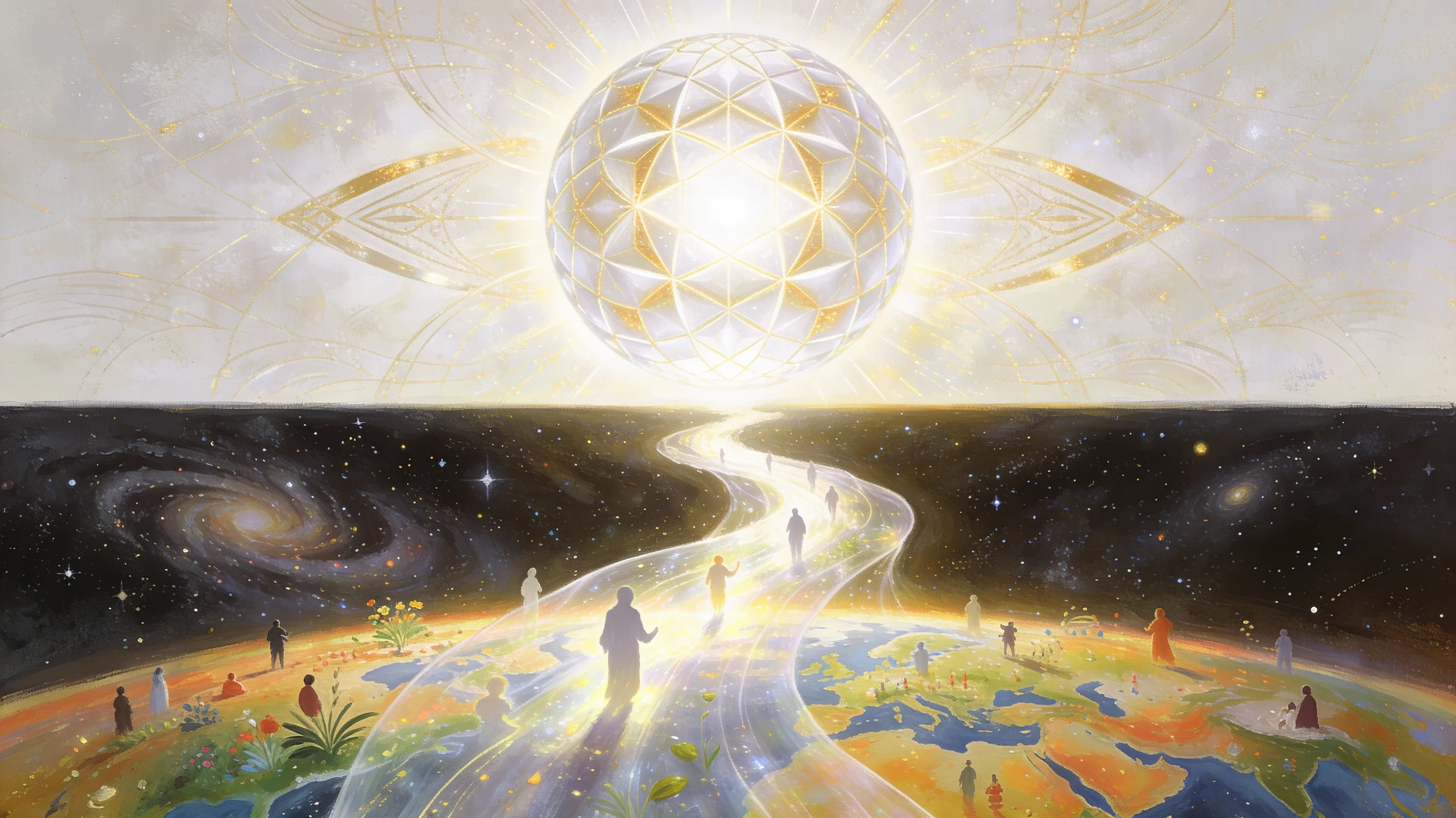
The concept of God in classical theism is predominantly one of perfection, immutability, and aseity. God is presented as the uncaused cause, the unmoved mover, a being of pure actuality with no potentiality for change. This framework, heavily influenced by Aristotelian metaphysics and articulated masterfully by theologians like Thomas Aquinas, posits a fundamentally asymmetric relationship between the Creator and the created.1 God acts, and the world is acted upon.
This classical view, however, presents a paradox that borders on incoherence when juxtaposed with a contingent world where events could have been otherwise. It posits that God is all-knowing, yet nothing within Him can be different from what it is. If a person freely chooses to perform one action over another, God’s knowledge must correspond to that choice. If the choice had been different, God’s knowledge would have to be different. This implies that the content of God’s knowledge is contingent upon our choices, which contradicts the notion of a purely actual, non-contingent being.
The Process Philosophy Solution
This is where the work of Alfred North Whitehead and, most notably, his student Charles Hartshorne, offers a compelling alternative. Hartshorne critiqued what he called the “monopolar prejudice” of classical theism, which defines God by only one pole of metaphysical contrasts (e.g., actual but not potential, absolute but not relative, necessary but not contingent), thereby creating an incoherent concept.2
Instead, process theology proposes a “dipolar” God. This model, originating with Whitehead and systematically developed by Hartshorne, does not deny that God is in some respects eternal and immutable, but it insists that God is also, in other respects, temporal and mutable. As Whitehead wrote, “The proper test is not that of finality, but of progress.”3
In this model, God has two “natures” or “poles”:
-
The Primordial Nature (The Abstract Pole): This is God’s abstract, eternal, and unchanging aspect. It is the realm of pure potentiality, containing all possibilities for the universe. It is the “unmoved mover” in the sense that it is the ultimate source of novel forms and ideals, luring the world toward its creative becoming.
-
The Consequent Nature (The Concrete Pole): This is God’s concrete, temporal, and ever-changing aspect. It is the result of what Hartshorne termed “divine relativity”—God’s intimate, responsive relationship with the world.4 God “prehends” or takes in every event that occurs in creation. Our choices, our creativity, and our suffering are not just known by God, but are felt by God and contribute to the divine experience.
In this view, God is in a genuine, give-and-take relationship with the world. Whitehead famously described God as the “fellow sufferer who understands.”5 God is not a distant, impassive monarch, but an intimate participant in the cosmic process.
Free Will and a Relational God
The classical model of a purely actual, immutable God, while philosophically influential, ultimately falters when confronted with the reality of a contingent world. For concepts like free will, a genuine divine-human relationship, and faith to be meaningful, we require a model of God who is not a distant, unaffected observer, but an active, responsive participant in the unfolding of creation.
Process theism provides such a model, offering a vision of a God who is both eternal and temporal, independent and relational. This allows for a universe where our choices truly matter, not only to ourselves but to the God who experiences the world with us, and whose own being is enriched by the progress of His creation.
Power, Love, and Persuasion
If process theology reimagines God’s relation to contingency, it also forces a rethinking of power. In classical theism, omnipotence is typically understood as the ability to bring about any logically possible state of affairs by sheer fiat. God’s will is conceived as a kind of infinite causal override, able to suspend, redirect, or annul creaturely action at will. Process theologians, by contrast, argue that this picture of power is both philosophically unstable and theologically disastrous.6 It leaves God either morally suspect for failing to prevent horrendous evil, or it empties free will of substance by reducing it to a decorative feature in an otherwise predetermined story.
Process thought reframes divine power as fundamentally persuasive rather than coercive. On this view, God is not the cosmic puppeteer who determines every movement of the world, but the ever-present lure toward richer, more harmonious forms of existence.7 God’s influence is real, continuous, and supreme in scope, yet it never unilaterally overrides the integrity of creaturely freedom or the causal regularities of the world. Instead of control, God offers invitation; instead of compulsion, God offers possibility.
Coercion and persuasion
To see the force of this shift, it helps to distinguish coercive from persuasive power. Coercive power imposes outcomes regardless of the recipient’s desires or decisions; it operates by shutting down alternative possibilities. Persuasive power, by contrast, works through the opening of new possibilities and the shaping of aims from within. It does not negate freedom; it presupposes and cultivates it.8 Process theologians contend that a genuinely personal relationship between God and creatures can only be sustained if God’s power is of the latter sort. A God who can at any moment override our deepest decisions would render freedom fragile and illusory.
Within a Whiteheadian framework, the world is composed of “occasions of experience,” each of which inherits a past, entertains multiple possible futures, and then actualizes one of them. God’s role is to provide each occasion with an “initial aim”—a divinely offered pattern of optimal realization, tailored to that occasion’s concrete situation.9 This aim is not an irresistible decree but a proposal; it can be partially accepted, distorted, or rejected by the creaturely process of decision. God’s power is thus located in the ceaseless provision of these aims and in the capacity to harmonize what the world has in fact become with new possibilities for well-being.
Contingency and divine risk
Once divine power is reconceived in this way, contingency is no longer a problem to be explained away but the very medium of God’s creative work. If God’s influence is persuasive rather than coercive, then the future is not a completed script hidden in the divine mind, but an open field of possibilities in which God and creatures genuinely co-author what comes to be. The risk of failure, tragedy, and missed possibilities is real, not illusory. Yet this risk is precisely what makes authentic love and freedom possible. A world in which every evil act were prevented by an invisible veto would also be a world in which no creature ever truly initiates, chooses, or loves.
In this process framework, God’s “foreknowledge” is not the possession of a fixed list of future events but the exhaustive grasp of all possibilities and their relational interconnections.10 God knows with perfect adequacy what can happen and how every possible choice would reverberate through the web of creation, but does not know as already actual what has not yet been decided by creaturely agency. Divine knowledge is thus complete with respect to possibility and perfectly responsive with respect to actuality: as new decisions are made, they are immediately prehended into the consequent nature of God and integrated into fresh aims for what is still to come.
This picture secures the intuition behind the original paradox: if free decisions could have been otherwise, then there is no timeless catalogue of settled future facts for God to consult. Instead of compromising divine perfection, process thinkers argue that this enhances it. A God who can creatively respond to an open future, integrating every contingency into new patterns of meaning and value, displays a more robust and dynamic perfection than a deity whose relation to the world is fixed in a single, timeless decree.
Love as the measure of power
The reconfiguration of omnipotence around persuasion rather than coercion also reframes the problem of evil. If God simply does not possess coercive power to unilaterally override the world’s causal structures, then the question “Why does God not step in and stop this particular instance of suffering?” is transformed. The process answer is not that God chooses not to intervene, but that God cannot intervene in that way without abolishing the very kind of world that makes moral freedom and experiential richness possible.11 God’s power is maximally expressed not in unilateral interruption, but in the subtle, persistent work of enabling new goods to emerge from even the most recalcitrant situations.
This does not trivialize suffering. On the contrary, since every event is taken into the divine life through God’s consequent nature, the wounds of creation become wounds in God.12 The “fellow sufferer who understands” is not a poetic flourish but a metaphysical claim: God literally feels every loss, every joy, every distortion of value that occurs in the world, and responds with new aims that seek to heal, transform, or at least honor what has been endured. Divine power is measured by the depth of this empathetic participation and the ingenuity with which God weaves new possibilities out of what the world has freely become.
Understood this way, love rather than control becomes the criterion of divine greatness.13 A God who can effortlessly impose any outcome but chooses instead to respect the integrity of creaturely agency may look “weaker” on a simplistic metric of power, but is morally and relationally greater. Process theology thus invites a revaluation of the very idea of omnipotence: God’s supremacy lies not in the capacity to dominate, but in the inexhaustible ability to call forth, suffer with, and creatively redeem a contingent world. This is a God whose perfection includes, rather than excludes, the vulnerability required for genuine relationship.
Footnotes
-
Thomas Aquinas, Summa Theologica, I, Q. 13, Art. 7. ↩
-
Charles Hartshorne, Man’s Vision of God and the Logic of Theism (1941). Hartshorne argues that classical theism fails to see that terms like “absolute” and “relative” are correlative and that a truly perfect being must encompass both poles. ↩
-
Alfred North Whitehead, Process and Reality (New York: The Free Press, 1978), 14. ↩
-
Charles Hartshorne, The Divine Relativity: A Social Conception of God (1948). In this key work, Hartshorne argues that God’s perfection is social and that God is “surrelative,” meaning God is related to all, but nothing is related to God in the same way. ↩
-
Alfred North Whitehead, Process and Reality, 351. ↩
-
Charles Hartshorne, Omnipotence and Other Theological Mistakes (Albany: SUNY Press, 1984). Hartshorne identifies omnipotence as the primary “theological mistake” and rejects what he calls the “tyrant conception of God.” ↩
-
Whitehead describes God as “the lure for feeling, the eternal urge of desire.” Alfred North Whitehead, Process and Reality, 344. ↩
-
David Ray Griffin, God, Power, and Evil: A Process Theodicy (Philadelphia: Westminster Press, 1976), 269–270. Griffin distinguishes coercive omnipotence from persuasive power, arguing that it is not logically possible for God to unilaterally control self-determining beings. ↩
-
Whitehead, Process and Reality, 244. God is the source of the “initial aim from which [the subject’s] self-causation starts.” ↩
-
John B. Cobb Jr. and David Ray Griffin, Process Theology: An Introductory Exposition (Philadelphia: Westminster Press, 1976), 52–56. ↩
-
Griffin, God, Power, and Evil, 280–281. See also Cobb and Griffin, Process Theology, 74–75: “Process theism cannot provide the assurance that God’s will is always done. It does affirm that, no matter how great the evil in the world, God acts persuasively upon the wreckage to bring from it whatever good is possible.” ↩
-
Whitehead, Process and Reality, 346. God “prehends every actuality for what it can be in such a perfected system—its sufferings, its sorrows, its failures, its triumphs, its immediacies of joy—woven by rightness of feeling into the harmony of the universal feeling.” ↩
-
Cobb and Griffin, Process Theology, ch. 3, “God as Creative-Responsive Love.” See also Whitehead, Process and Reality, 343, where Whitehead contrasts his vision of God with imperial imagery, suggesting that “the Galilean origin of Christianity” points to a God whose power lies not in ruling force but in “a tender care that nothing be lost.” ↩